Executive Summary
Modern AI agents can now plan, reason, and execute complex software tasks with impressive autonomy. But raw capability is not enough to make them effective contributors. Like any new team member, agents need context, structure, and a way to learn from experience. This framework explains how to give AI agents the knowledge, skills, and feedback loops required to become reliable and productive teammates.
The Shift Underway
Many leaders still think of AI coding tools as smarter versions of autocomplete. That mental model is already outdated.
Today’s AI agents can understand entire codebases, design multi-file implementations, refactor systems while preserving test coverage, debug problems methodically, and even review and improve their own work. In practical terms, they behave less like utilities and more like junior developers who never sleep.
Yet most organizations continue to treat them like simple tools. We assign agents to complex projects without explaining business rules, architectural history, or the lessons learned from past failures. We expect good outcomes without providing meaningful onboarding.
The result is predictable. Agents produce code that may be technically correct but contextually wrong. They solve the problem they were asked to solve, not the problem the organization actually needs solved.
To change that outcome, we need to rethink how we integrate AI into the software development process.
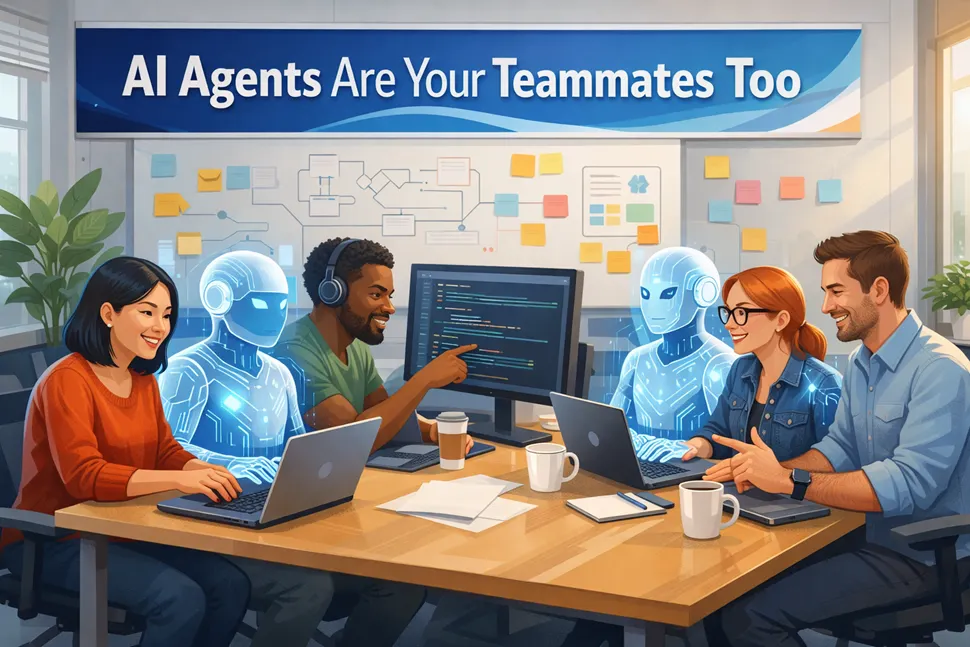
What Makes AI Agents Effective
AI agents need the same things human developers need to succeed.
Project Knowledge
Agents must understand the environment in which they operate. That includes business constraints, architectural decisions, team conventions, and prior bugs or hard-earned lessons. Without this knowledge, they work in isolation, generating solutions that ignore important realities. With it, they can align their output to the true needs of the project.
Structured Skills
Agents also need repeatable ways of working. They should follow clear procedures for planning tasks, debugging systematically, writing tests early, and verifying results. These protocols prevent improvisation and reduce the most common failure modes of AI-generated code.
A Learning Loop
Perhaps most importantly, AI development should not be stateless. Every interaction should improve the next one. Agents must be able to consume prior knowledge, capture new lessons, and avoid repeating mistakes. This idea is often described as compound engineering: the notion that improvements accumulate over time rather than disappearing after each session.
The goal is simple. Agents should become better collaborators the longer they work with your team.
The Compound Engineering Framework
Turning these principles into a repeatable practice requires three layers.
~/.cursor/rules/                         # GLOBAL (shared across projects)
├── compound-engineering.mdc             # Methodology: WHEN & WHAT
└── superpowers-*.mdc                    # Skills: HOW

<project>/.cursor/rules/                 # PROJECT-SPECIFIC
├── [symlinks to global rules]
└── project-knowledge.mdc                # Project learnings (committed)

<project>/docs/
├── knowledge/                           # Stable reference docs
├── designs/                             # Solution architecture
└── plans/                               # Implementation plans
1. The Project Knowledge Layer
At the foundation is a persistent knowledge base that agents consult before every task. This layer captures business rules, architectural rationale, lessons learned, and key system concepts. It transforms agents from generic coders into collaborators who understand the project as deeply as any experienced developer.
Without this layer, every new task starts from scratch. With it, each task begins with institutional memory already in place.
project/
├── .cursor/rules/
│   ├── project-knowledge.mdc    # THIS project's learnings (committed)
│   └── [symlinks to global rules]
│
└── docs/
    ├── knowledge/               # Stable reference documentation
    │   ├── architecture-decisions.md
    │   ├── api-contracts.md
    │   ├── data-dictionary.md
    │   └── requirements/
    │
    ├── designs/                 # Solution architecture (permanent)
    │   └── *.md
    │
    └── plans/                   # Implementation plans (ephemeral)
        └── YYYY-MM-DD-*.md
2. The Skill Layer
Above the knowledge layer sit reusable protocols that guide agent behavior. These include structured approaches for brainstorming options, planning work, following test-driven development practices, debugging methodically, and verifying outcomes with evidence rather than confidence.
These skills give agents a disciplined operating model. Instead of guessing at the next step, they follow proven patterns that mirror how high-performing teams build software.
Several practical toolkits already exist to help implement this layer, including Claude Code skills and Cursor agent rules. The specific technology matters less than the principle: agents should operate according to explicit, shared procedures.
3. The Methodology Layer
The final layer defines an overall workflow optimized for agent productivity. In this model, planning and verification receive far more emphasis than raw code generation. A healthy distribution of effort might involve spending roughly forty percent of time understanding context and designing solutions, only ten percent on implementation, and the rest on assessment and capturing new knowledge.
This approach reflects an important reality. The bottleneck in AI-assisted development is rarely typing code. The real value lies in deciding what to build and ensuring it is built correctly.
What This Changes
When these layers are in place, the role of AI in a software organization shifts in meaningful ways.
Agents Become Real Contributors
With proper context and skills, agents can own features end to end, follow architectural standards, learn from feedback, and self-verify their work. They stop being clever assistants and start behaving like productive teammates.
Human Roles Evolve
Developers spend less time writing routine code and more time reviewing, teaching, and designing systems. The focus moves from implementation details to higher-level decisions. AI amplifies human talent instead of replacing it.
Knowledge Becomes a Durable Asset
Institutional memory no longer lives only in Slack threads and individual minds. It becomes an asset that agents actively use and improve. Over time, this creates a compounding advantage that is difficult for competitors to replicate.
Implementation Reality
Adopting this framework is not a matter of installing a plugin. It requires three deliberate steps.
First, teams must build a real knowledge base that captures rules, architecture, and past lessons in a form agents can consume. Second, they need to configure structured skills so agents follow consistent workflows. Third, organizations must adapt their culture to treat AI as a teammate that learns rather than a tool that answers questions.
This is an investment in process and discipline, not just in technology.
The Competitive Dimension
AI models themselves are rapidly commoditizing. Every company can access similar underlying technology. The real differentiator is context.
Organizations that accumulate project knowledge for their agents gain advantages that competitors cannot easily copy. Each month of captured lessons makes their agents more effective, and that effectiveness compounds over time.
Five Diagnostic Questions
To evaluate whether your organization is using AI strategically, consider a few simple questions.
Do your agents begin each task with real project context?
Does feedback from one task improve performance on the next?
Are agents following structured, repeatable workflows?
Are you measuring agents as contributors rather than novelties?
Is institutional knowledge accessible to AI systems?
If the answer to any of these is no, you are likely paying for AI without realizing its full potential.
Bottom Line
AI agents can become powerful software teammates, but capability alone produces inconsistent results. To unlock their value, organizations must provide project knowledge, structured skills, and continuous learning loops.
Do that, and your agents will improve with every feature they deliver.
The real question is not whether AI can help build software. The real question is whether you will build an organization where it can.